
Environmental Sustainability

Issue Date:August 21, 2026
 

Environmental Sustainability


Sustainability Strategies, Performance, and Goals


Material Topics and SDGs

Indicators

Goals for 2025

2025 Performance

Achievement Status

Short-Term Goals (2026–2028)

Mid-Term Goals (2029–2031)

Long-Term Goals (2032–2034)

Climate ChangeAbsolute reduction ratio of greenhouse gas emissions (Scope 1 and Scope 2)18.3%45%
32.1%45.8%59.6%
Absolute reduction ratio of greenhouse gas emissions (Scope 3)10.9%88%
19.1% 27.3%35.5%
Electricity intensity reduction ratio7%3%
10%13%16%
Renewable energy usage ratio as a percentage of annual electricity consumption15%16%
21% 27% 33%
Nature and Climate Management Framework


Core Element

Management Strategies and Actions

2025 Implementation Status

Governance

  • The Board of Directors regularly reviews nature-related dependencies, impacts, risks, and opportunities, as well as climate change-related risks and opportunities.

  • The ESG Committee regularly reports nature- and climate-related strategies and implementation results to the Board of Directors.

  • The Environmental Protection Committee and Sustainable Energy Committee are responsible for setting goals and plans and executing related strategies in coordination with the TCFD Team and TNFD Team. 

  • Participate in domestic and international initiatives.
     

  • The ESG Committee is led by the Chairman, and the committee member and executive representative - the CFO (Chief Financial Officer) reports to the Board of Directors annually on sustainability project implementation results, TCFD, TNFD, various environmental indicators, SBT carbon reduction targets and roadmap, renewable energy strategies, and future sustainability development directions. In addition, greenhouse gas inventories implementation status is reported to the Board of Directors on a quarterly basis.

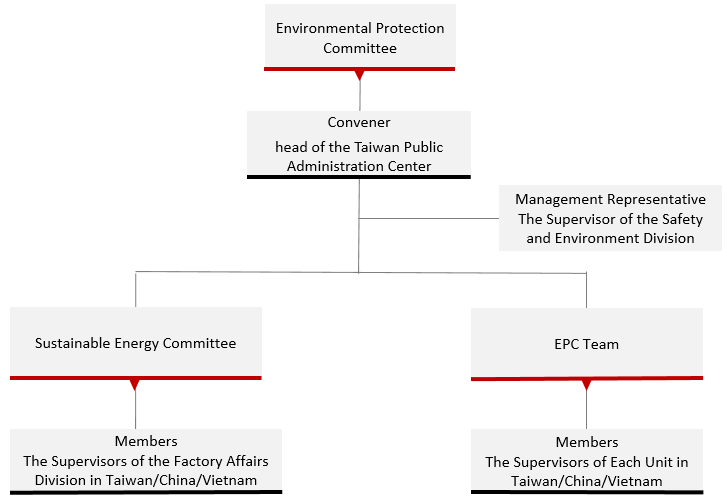
  • The Environmental Protection Committee is chaired by the head of the Taiwan Public Administration Center. Its subordinate Sustainable Energy Committee and EPC Team are responsible for setting short-, medium-, and long-term environmental goals and strengthening strategy implementation.

  • The TCFD Team is convened by the head of the Taiwan Public Administration Center and conducts climate-related risk and opportunity assessments every two years. It develops response strategies and solutions based on the assessment results to mitigate negative impacts and enhance organizational climate resilience.

  • The TNFD Team is convened by the head of the Taiwan Public Administration Center and is responsible for conducting nature-related dependency and impact assessments and formulating response strategies and solutions to reduce negative impacts on nature.

  • The Company signed and supported TCFD, joined the TNFD Forum, the “Taiwan Climate Partnership” and the “Taiwan Alliance for Net Zero Emission”, responded to CDP Climate Change and Water Security questionnaires, set SBT targets based on the 1.5°C scenario, submitted them to SBTi, and received SBTi approval in 2024.

  • In 2025, the Company updated its “Biodiversity Conservation and No Gross Deforestation Commitment” and “Environmental Sustainability Policy”, both were signed and announced by the Chairman.


Strategy

  • Assess the Company’s nature-related dependencies and impacts through overlay analysis and the Biodiversity Risk Filter (BRF) developed by the World Wildlife Fund (WWF).

  • Identify short-, medium-, and long-term climate-related risks and opportunities through cross-departmental discussions.

  • Assess the potential operational and financial impacts of significant climate-related risks and opportunities on the Company.

  • Conduct scenario analysis and evaluate SBT carbon reduction targets.
     

  • Priority was given to coordinate overlay analysis for the Company’s directly operated sites, with future expansion planned for all Group operational sites and value chains.

  • The WWF BRF was used to identify items with high biodiversity dependency and impact within direct operations. Based on the Science-Based Targets for Nature (SBTN) AR3T framework (Avoid, Reduce, Regenerate, Restore, and Transform), the Company established nature-related targets and action guidelines.

  • The Environmental Protection Committee, together with relevant units, established short-, medium-, and long-term environmental sustainability targets and identified short-, medium-, and long-term climate risks and opportunities. Scenario simulation quantitative models were then introduced based on the identification results to conduct monetary assessments of potential financial impacts and formulate climate adaptation strategies.

  • Developed low-carbon technologies and designed energy-efficient, low-power green products.

  • In alignment with the Paris Agreement goal of “limiting global warming to below 2°C”, the Company adopted the 1.5°C scenario for setting absolute emission reduction targets under the Science-Based Targets (SBT) framework.

  • Established SBT carbon reduction targets, strategies, and roadmap.
     

Risk Management

  • Utilize the TNFD and TCFD frameworks to identify the Company’s nature- and climate-related risk identification processes.

  • Incorporate nature- and climate-related risk identification and assessment into enterprise risk management processes.

  • Develop corresponding response plans based on the results of climate risk identification and prioritization.
     

  • Adopted the TNFD LEAP methodology to progressively identify nature-related dependencies and impacts at the Company’s Taiwan and China plants, with future expansion planned for all Group operational sites and value chains.

  • Beginning in 2026, the Company will publish an annual TCFD & TNFD Report.

  • Assessed the types of potential operational and financial impacts associated with climate-related risks and opportunities.

  • Incorporated nature- and climate change-related risk topics into the overall risk management process and annual material sustainability topics to comprehensively identify, assess, and manage nature- and climate-related risks.
     

Metrics and Targets

  • Establish nature- and climate -related management indicators.

  • Conduct regular GHG inventories in accordance with ISO 14064-1.

  • Review and manage energy performance regularly in line with ISO 50001.

  • Set environmental management targets and periodically review progress and actual performance.

  • Plan and implement product carbon footprint inventory.
     

  • Committed to achieving No Net Loss and progressing toward a Net Positive Impact by 2050, while simultaneously achieving the No Deforestation target.

  • Established targets for the usage rate of recycled raw materials, environmentally friendly cushioning materials, and packaging materials, and regularly reviews implementation results to reduce product impacts on the natural environment.

  • Set environmental performance indicators including absolute GHG emissions, electricity intensity, waste recycling rate, water consumption, and renewable energy usage rate, with quarterly and annual reviews to reduce environmental impacts.

  • Since 2016, GHG emissions have been verified annually; from 2020, the scope of inventory has expanded to Scope 3, using ISO 14064-1:2018, followed by implementation of emission reduction measures based on the inventory results.

  • Taiwan plants, Coretronic Optotech (Suzhou), Coretronic Optics (Suzhou), and Coretronic Projection (Kunshan) have implemented the ISO 50001 Energy Management System, effectively reducing absolute GHG emissions through energy-efficient equipment upgrades and other energy conservation measures.

  • The SBT carbon reduction targets, “Reduce absolute Scope 1 and 2 GHG emissions 50.4% by 2032 from a 2021 base year, and reduce absolute Scope 3 GHG emissions 30% within the same timeframe”, were approved by SBTi in April 2024. The Company is gradually progressing toward SBT and 2050 Net-Zero targets through solar power generation system installation, production process optimization, increased renewable energy usage, equipment upgrades, and low-carbon product development.

  • Solar power system capacity at the Headquarters, Chunan Plant, Tainan Plant 1, and Tainan Plant 2 reached 1,376.06 kW, generating 1,112 MWh of electricity in 2025. Combined with green power wheeling, total renewable energy usage reached 1,256 MWh. The installed capacity of solar power generating systems at the China plants totaled 6,549 kW, generating 4,791 MWh of electricity in 2025 and adding 2,093 MWh from renewable energy certificates, resulting in total renewable energy usage of 6,884 MWh. Together, Taiwan and China plants used or traded a total of 8,140 MWh of renewable energy, accounting for 16% of annual electricity use and exceeding the short-term target. Phase II of the Tainan Plant 2 solar project completed installation of a 460.35 kW solar power generation system in December 2025 and is scheduled to commence operation in 2026, with expected annual electricity generation of 567 MWh. The Company will continue progressively increasing renewable energy usage targets in the future.

  • Three laser projector models and two LCD monitor models have passed ISO 14067 verification, serving as benchmarks for the Company’s development of future sustainable products.

  • The Company established a green product development strategy and completed the construction of a product carbon footprint inventory platform, while conducting system validation for mass-production models. In the future, carbon footprint inventories will be prioritized for newly developed products, enabling identification of carbon emission hotspots during the product design and development stage. Through technological innovation, material substitution, and performance optimization, environmental impacts can be reduced and incorporated into next-generation product development standards, thereby providing more environmentally friendly and energy-efficient green products to meet customer needs. For details, please refer to "Green Product".

Environmental Sustainability Policy

Coretronic Corporation actively promotes climate governance and initiates climate adaptation actions. Coretronic has set carbon reduction targets aligned with the SBT 1.5°C scenario and net-zero pathway. Strategies include increasing the use of renewable energy, improving energy efficiency, implementing energy-saving measures, adopting environmental management systems, and integrating low-carbon concepts into product development technologies and manufacturing processes. By developing low-carbon innovative products that combine economic value with environmental benefits, combined with other carbon reduction strategies, Coretronic aims to gradually achieve the long-term goals of net-zero emissions by 2050 and 100% renewable energy usage by 2050.

  • This policy covers all operational activities. The scope of application includes all companies and related organizations within the Coretronic Group, as well as internal and external stakeholders such as suppliers, contractors, and value chain partners. Additionally, environmental risk assessments are incorporated as part of due diligence procedures conducted prior to the establishment of subsidiaries, mergers, or acquisitions. 

  • Comply with or exceed domestic and international environmental regulations and sustainability requirements, actively conform to international initiatives and voluntary commitments, and conduct regular regulatory audits to ensure that current practices align with the latest legal standards. 

  • Strengthen source waste reduction and pollution prevention, continuously promote a green supply chain, green manufacturing, and innovative green R&D technologies, gradually phase out hazardous substances, and minimize environmental impact at all stages of the product life cycle, including design, raw materials, manufacturing, transportation and distribution, use, and disposal. 

  • Actively promote various environmental protection actions and training programs to foster and deepen environmental awareness, responsibility and engagement among employees and external stakeholders. 

  • Engage in discourses, evaluations, and audits to communicate, discuss, and share issues related to environmental sustainability with internal and external stakeholders, including customers, suppliers, value chain partners, local communities, and the wider society. When formulating or implementing policies, Coretronic consults external stakeholders to expand positive impacts. 

  • Establish an environmental management system in accordance with international standards and identify environmental risks and opportunities. The environmental management unit convenes relevant departments to jointly develop priority improvement action plans, set environmental sustainability goals, and define measurable performance indicators. The Environmental Protection Committee regularly reviews the effectiveness of these action plans and drives continuous improvement to ensure the achievement of each environmental sustainability target. The ESG Committee regularly reports climate change strategies and implementation performance to the Board of Directors, thereby assisting the Board in managing risks and opportunities, with the goal of reducing environmental impacts and promoting corporate sustainability.


Environmental Protection Committee


Upholding the aim to implement energy conservation mechanisms, reduce greenhouse gas emissions, fulfill corporate social responsibility, improve the overall corporate image, reduce operating cost, and assure sustainable business and development, Coretronic established the Environmental Protection Committee (EPC) in 2015. The head of the Integrated Business Service serves as the “Convener”, the divisionlevel manager of the Integrated Business Service serves as the “Committee Chair”, the supervisor of the Safety and Environment Division serves as the “Management Representative”, and the supervisors of each unit or representative such as R&D, Manufacturing, Quality Assurance, Procurement, Facility Management, Safety and Environment, and Factory Affairs serve as “Members”. Additionally, the Company set up the Sustainable Energy Committee and the EPC Team under the jurisdiction of the EPC.


  • Environmental Protection Committee and EPC Team

    ✔ Review short-, medium-, and long-term net-zero goals and implementation results on a quarterly and annually basis.
    ✔ Establish, plan, and implement targets, strategies, and action plans for climate change, carbon peaking, carbon neutrality, and net-zero.
    ✔ Conduct climate-related risks and opportunities identification.
    ✔ Promote pollution prevention, emergency response, and preventive measures.
    ✔ Focus on and advocate key points of international initiatives.
    ✔ Integrate and implement measures related to green actions.

  • Sustainable Energy Committee 

The division-level manager of the Integrated Business Service serves as the “Committee Chair”, and the supervisors of the Factory Affairs Division from each factory serve as “Members”. 
✔ Review electricity, renewable energy, and water resource usage on a weekly, monthly, and quarterly basis.
✔ Promote corporate energy conservation, carbon reduction projects, and energy transition.
✔ Implement short-, medium-, and long-term net-zero strategies and goals.
✔ Report the status of goal achievement to the EPC on a quarterly basis.